How AZ Rank proved that in a sensitive, medium-high competition niche, a controlled low-volume strategy with high-conversion keyword selection outperforms aggressive volume plays.
From Position 15 to #1 — Both Keywords — With a Slow and Steady 28-Day Approach
How AZ Rank proved that in a sensitive, medium-high competition niche, a controlled low-volume strategy with high-conversion keyword selection outperforms aggressive volume plays.
Overview
This case study documents a ranking campaign in the Women’s Health (Vaginal Care) niche — a sensitive category with medium-high competition and limited promotional flexibility. The product was ranked using a controlled, low-volume strategy over 28 days, prioritising conversion rate over raw search volume when selecting keywords.
The campaign ran from December 10, 2025 through January 23, 2026 with 90 total units distributed across 28 days at a slow and steady pace. The result: both target keywords climbed from their starting positions all the way to #1 — and held there well beyond the campaign’s end date.
The Challenge
Three factors made this campaign distinctly different from a standard ranking exercise:
Sensitive Category
Women’s health / vaginal care products have limited promotional flexibility on Amazon. Standard promotional tactics used for general consumer goods are not viable here.
Established Brand Competition
The category is dominated by established brands with deep review counts, strong BSR histories, and loyal customer bases — making every ranking position harder to take.
Controlled Daily Units Required
The strategy required a deliberate, low-volume daily approach — not because of budget, but because steady consistent velocity signals are more effective than burst activity in this niche.
Goals
Increase Visibility for High-Intent Keywords
Get the product ranking for search terms used by buyers actively ready to purchase — not broad exploratory terms.
Drive Growth with Consistent, Low-Volume Strategy
Prove that a slow-and-steady distribution of units over 28 days beats an aggressive short burst for ranking stability.
Sustain Stable Rankings Post-Campaign
Achieve rankings that hold and continue improving organically after the campaign concludes — without ongoing spend to maintain position.
Strategy
The approach followed AZ Rank’s standard three-step framework, adapted for the unique constraints of a sensitive health niche:
Niche Analysis — Validate Demand & Intent
Reviewed actual search demand for the category’s keyword set, assessed competitor pricing and BSR depth, and confirmed that buyer-intent terms in this niche have measurably high conversion rates above 8%.
Decide on Numbers — 90 Units Over 28 Days
Based on keyword analysis and niche dynamics, 90 surveys total were planned across a 28-day campaign window. This translates to roughly 3–4 units per day — deliberately slow and consistent rather than front-loaded or bursty.
Planning — Conversion-First Keyword Selection
Rather than targeting the highest-volume terms, keyword selection prioritised conversion rate over traffic size. Both selected keywords carried 8%+ CVR — a strong signal of high buyer intent that makes each unit’s ranking contribution significantly more efficient.
The daily plan ran from December 10, 2025 to January 23, 2026, with a deliberate pause over the Christmas period and a resumption in early January. The full schedule:
| Date | Units / Day | Date | Units / Day |
|---|---|---|---|
| 12/10 | 2 | 01/08 | 3 |
| 12/11 | 3 | 01/09 | 2 |
| 12/12 | 3 | 01/10 | 3 |
| 12/13 | 4 | 01/11 | 2 |
| 12/14 | 3 | 01/12 | 3 |
| 12/21 | 3 | 01/13 | 2 |
| 12/22 | 4 | 01/14 | 3 |
| 12/23 | 4 | 01/15 | 2 |
| 12/24 | 3 | 01/16 | 4 |
| 12/25 | 1 | 01/17 | 3 |
| 12/26 | 5 | 01/18 | 4 |
| 12/27 | 5 | 01/19 | 3 |
| 01/20 | 4 | ||
| 01/21 | 4 | ||
| 01/22 | 4 | ||
| 01/23 | 4 |
Conversion Rate Justification — Why These 2 Keywords?
Keyword selection in a sensitive health category is more nuanced than simply picking the highest-volume terms. The two keywords chosen carried strong buyer conversion rates above 8% — meaning a meaningful proportion of shoppers who search these terms actually purchase. This matters because it signals genuine buyer intent and means that campaign units carry more algorithmic weight per order.
| Keyword Phrase | Keyword Sales | Search Volume | Competing Products | Keyword CVR | Day 0 | 01/23 (last day) | |
|---|---|---|---|---|---|---|---|
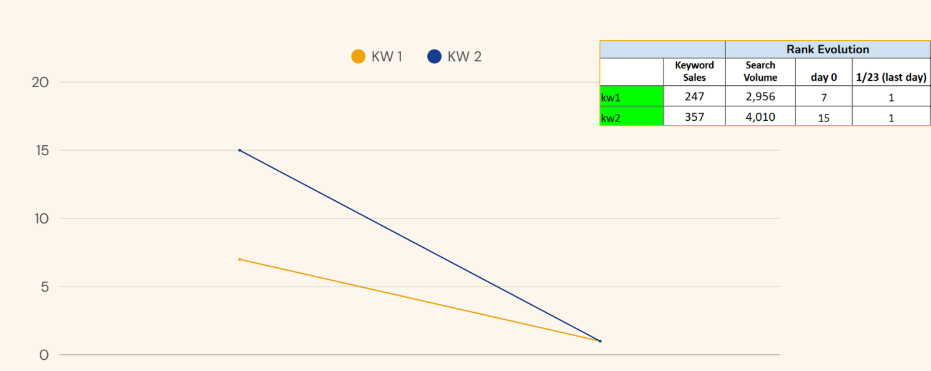
| KW1 | vaginal dryness | 247 | 2,956 | >1,000 | 8.36% | 7 | 1 |
| KW2 | vaginal moisturizer | 357 | 4,010 | >922 | 8.90% | 15 | 1 |
Execution
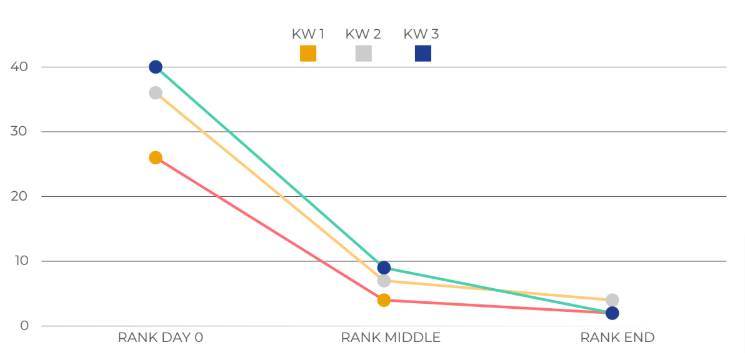
Throughout the 28-day campaign, the team maintained continuous oversight — tracking rank evolution daily, making on-spot adjustments where needed, and collecting structured customer survey feedback with every order. By the final day (January 23, 2026), both keywords had reached position #1:
The survey data collected during execution also gave the seller a rich batch of customer intelligence. Respondents provided feedback on product safety, formulation preferences (capsule vs. suppository vs. gummy), ingredient transparency, competitive differentiators, and usage questions — all valuable inputs for listing optimisation and future product development.
Keyword Rankings at End of Campaign
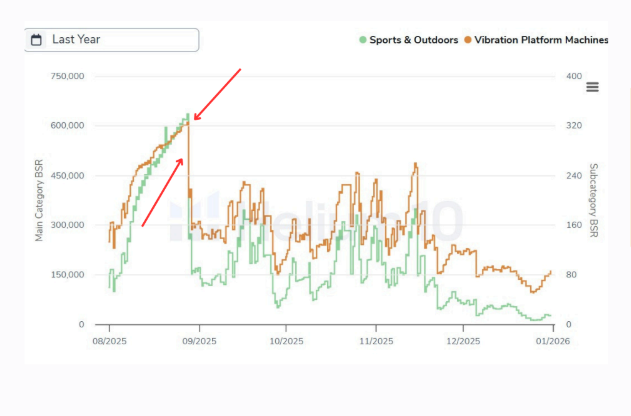
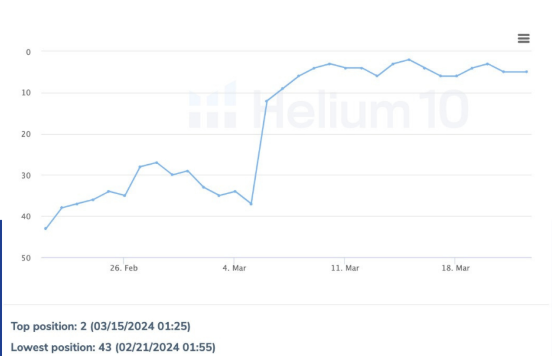
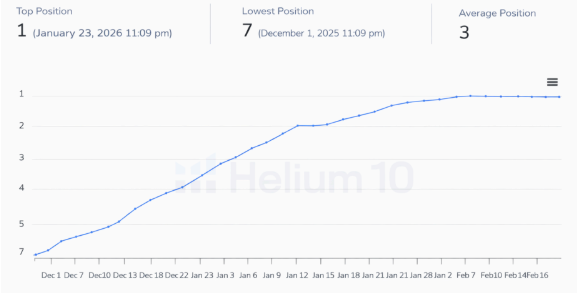
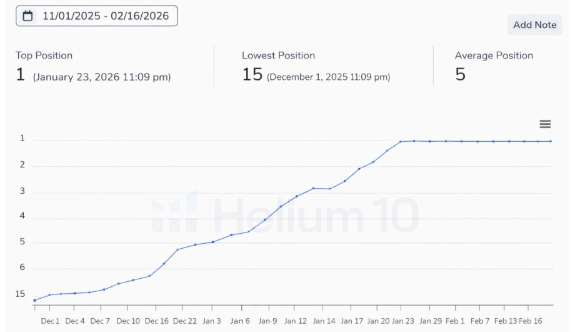
The Helium 10 tracking graphs tell the full story of how each keyword evolved from campaign start through to mid-February 2026 — well after the campaign ended.
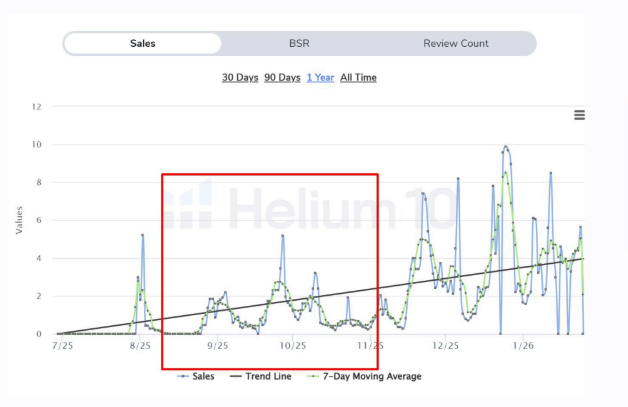
Sales Insights
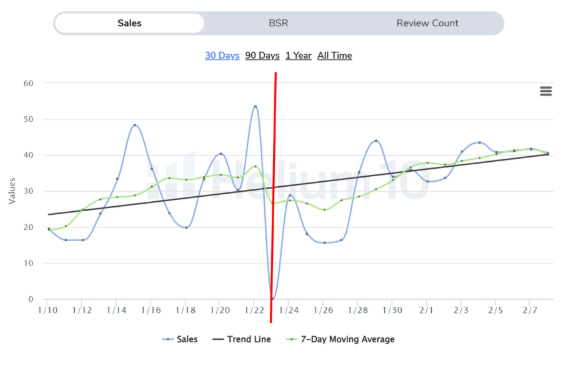
The 30-day sales view shows the period immediately surrounding the campaign end date. The red vertical line marks the end of the campaign (January 23, 2026). The key takeaway is in the trend line, not the daily fluctuations: the overall trajectory is upward and the positive slope was sustained well beyond the campaign’s conclusion.
Keyword Evolution — 4 Weeks After Campaign
Four weeks after the campaign concluded, both keywords were checked in Helium 10. The positions held at strong levels, and notably, the search volume data showed meaningful organic demand increases — with “vaginal moisturizer” growing to 8,851 searches and “vaginal dryness” to 5,931.
| Keyword Phrase | Search Volume (Feb 15) | Position (Feb 15) |
|---|---|---|
| vaginal moisturizer | 8,851 | #5 |
| vaginal dryness | 5,931 | #4 |
Strong ranking maintained four weeks out, and organic demand increased more than 2x compared to the search volumes at campaign start. This confirms the campaign’s core hypothesis: controlled low-volume execution in a high-CVR niche produces durable ranking gains that feed ongoing organic growth.
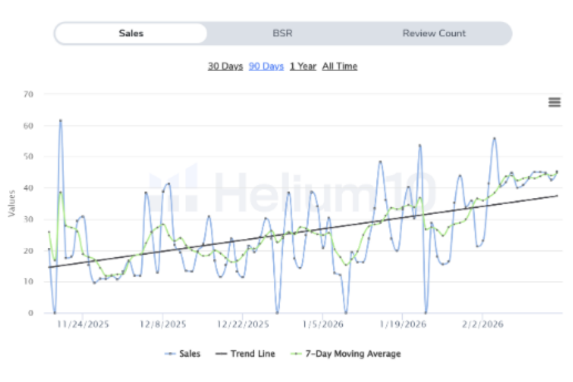
Sales Evolution — 4 Weeks After Campaign
The 90-day sales view captures the full picture from campaign launch through four weeks post-campaign. The trend line shows a clear upward baseline — higher daily sales floors, higher peaks, and no artificial activity spikes that might flag anomalous behaviour. This is organic growth, not a temporary boost.
The Real Cost of This Campaign
A transparent cost breakdown shows why the gross budget figure overstates the actual investment. Amazon’s FBA disbursement cycle returns a significant portion of the purchase price back to the seller, making the true net cost substantially lower than the headline number.
The initial cashflow required of $3,051 looks significant, but Amazon disburses $1,482 back to the seller — leaving the true campaign cost at just $1,569.39, or $17.44 per unit. The actual investment was nearly 50% lower than the headline number. For a product priced at $23.99, that is an efficient cost-per-ranking unit in a medium-high competition niche.
Summary
- KW1 (vaginal dryness, 2,956 searches/month, 8.36% CVR) moved from position 7 → #1 by campaign end.
- KW2 (vaginal moisturizer, 4,010 searches/month, 8.90% CVR) moved from position 15 → #1 by campaign end.
- Both rankings held and continued to strengthen 4 weeks after campaign conclusion.
- Organic demand increased 2x+ post-campaign: “vaginal moisturizer” grew to 8,851 searches and “vaginal dryness” to 5,931.
- Sales trend line showed consistent upward growth from campaign period through February 2026 — with no artificial spikes.
- True campaign net cost: just $1,569.39 total — $17.44 per unit — after Amazon disbursements (48% lower than gross).
- Key proof point: in sensitive, competitive niches, conversion rate selection + steady pace outperforms aggressive volume plays every time.
© AZ Rank — Case Study #6: Women’s Health · Vaginal Care · Steady 4-Week Campaign
Image URLs: All four localhost image URLs have been replaced with https://azrank.com/… paths. Please verify this domain is correct for your live WordPress installation and update if needed.
No style block was present in this file — styles were already inline, so no stylesheet conversion was required. The output is a clean, class-free, inline-only snippet wrapped in a single outer div.
Responsive behaviour: No media queries were present in the source, so nothing was dropped. Flex layouts will wrap naturally on narrow screens due to flex-wrap: wrap and min-width values already in place.