How AZ Rank proved that premium, high-ticket fitness products can rank efficiently with minimal order volume — breaking the myth that ranking requires aggressive daily spend.
From Outside Top 300 to Position #1 — With Only 12 Units
How AZ Rank proved that premium, high-ticket fitness products can rank efficiently with minimal order volume — breaking the myth that ranking requires aggressive daily spend.
Overview
This case study documents a ranking campaign for a premium vibration plate / shake plate in the Fitness Equipment, Vibration Plates & Home Gym Products niche. What makes this case unique is the product’s high price point — around $160 per unit — which fundamentally changes the economics and strategy of any ranking campaign.
In standard Amazon ranking campaigns, sellers use relatively high daily unit volumes to generate the sales velocity needed to move the algorithm. For a $160 product, that approach is cost-prohibitive. This case study shows that with the right keyword targeting and timing, even just 12 units over 8 days can move a product from complete obscurity into a strong top-25 position.
The Challenge — Ranking a High-Ticket Product
The fundamental tension in ranking a premium product is straightforward: the more you spend per unit in giveaways, the fewer units you can afford to give. Standard ranking campaigns that use 15–25 units per day become economically impractical at $160/unit. This forced a different strategic approach from the outset.
High Price Limits Daily Volume
At $160/unit, each survey represents a significant cash outlay. Aggressive daily volumes are simply not budget-viable for most sellers at this price point.
Aggressive Velocity Not Sustainable
Unlike a $25 supplement, you cannot run 20 units/day for 30 days on a $160 product without burning through a substantial budget.
Strategy Must Prioritise Efficiency
Success depends on selecting the right keywords — high-intent, buyer-ready terms that respond quickly to low unit volume rather than requiring sustained high velocity.
Goals
Improve Visibility for High-Intent Keywords
Get the product indexed and ranked for search terms used by buyers who are actively ready to purchase, not just browsing.
Validate Low-Volume Ranking for Premium Products
Prove that with the right keyword selection, even 1–2 units per day can produce measurable, sustained ranking movement for a high-ticket item.
Achieve Stable Long-Term Ranking Growth
Build ranking momentum that continues improving organically after the campaign ends, without requiring ongoing heavy spend to maintain.
Strategy
The strategy for a high-ticket product differs significantly from a standard campaign. Rather than maximising daily unit volume, the approach focused on keyword precision — identifying the terms where even low velocity would signal buying intent strongly enough to shift rankings.
Niche Analysis — Validate Demand & Intent
Validated actual search demand for the product’s keyword set, reviewed competitor pricing and positioning, and set realistic unit targets compatible with the product’s economics.
Decide on Numbers — Just 12 Units Total
Based on the keyword analysis and product price point, only 12 surveys were needed across the entire 8-day campaign. This is the most efficient campaign volume in any AZ Rank case study documented — roughly 1–2 units per day.
Planning — Keyword-Led, Even Distribution
A keyword-led plan was built with even unit distribution across 8 days, aligned to the campaign budget. The plan prioritised high-intent terms (shake plate, vibrating plate) over broad category terms.
| Date | Units / Day | Date | Units / Day |
|---|---|---|---|
| 08/26 | 1 | 08/30 | 2 |
| 08/27 | 1 | 08/31 | 2 |
| 08/28 | 1 | 09/01 | 2 |
| 08/29 | 1 | 09/02 | 2 |
Execution
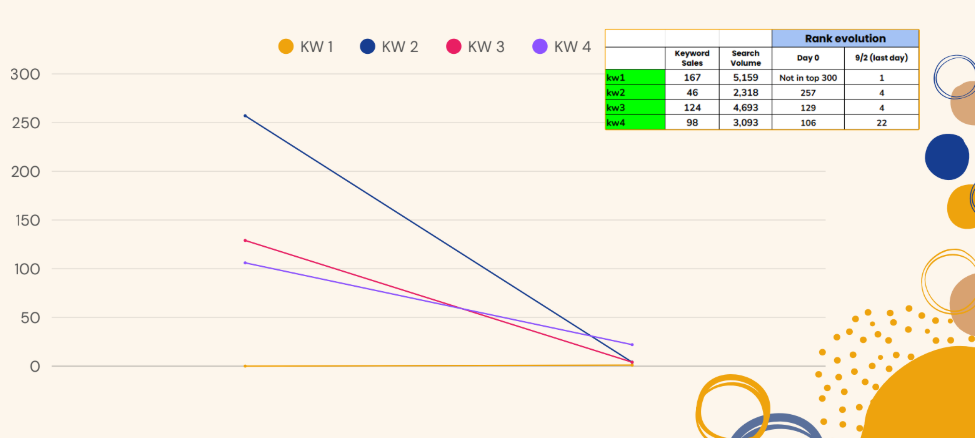
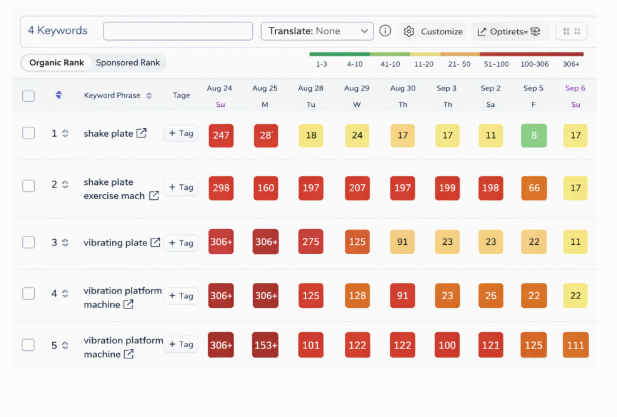
Throughout the 8-day campaign, the team tracked rank daily and made on-spot adjustments. The rank evolution results by the final day (9/2) confirmed strong movement across all four keywords:
| Keyword | KW Sales | Search Volume | Day 0 | 9/2 Last Day | Movement |
|---|---|---|---|---|---|
| KW1 — shake plate | 167 | 5,159 | Not in top 300 | #1 | +300+ |
| KW2 — shake plate exercise machine | 46 | 2,318 | 257 | #4 | +253 |
| KW3 — vibrating plate | 124 | 4,693 | 129 | #4 | +125 |
| KW4 — vibration platform machine | 98 | 3,093 | 106 | #22 | +84 |
The headline result: KW1 (“shake plate”) moved from completely unranked (outside top 300) to position #1 — the most high-intent keyword in the set, responding exactly as predicted to low-volume precision targeting. Buyers also provided structured survey feedback covering product features, vibration intensity levels, ease of use, and safety — giving the seller a valuable batch of customer intelligence alongside the ranking gains.
Rank Evolution
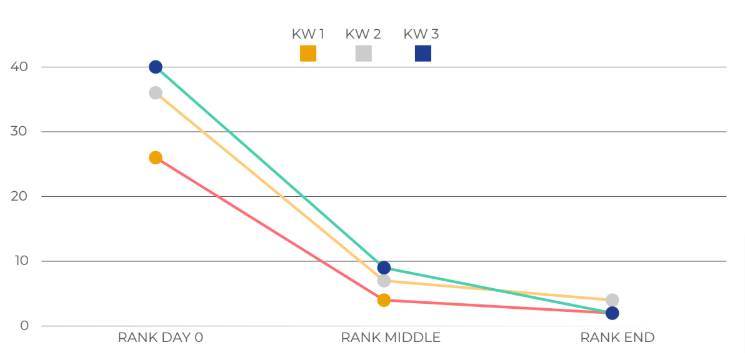
The evolution chart dramatically illustrates what 12 units can do when deployed on the right keywords. KW1 starts off the chart entirely (no position at all) and lands at #1. KW2, starting at 257, falls to just #4. The steepness of the lines reflects how responsive high-intent, niche-specific terms are to even minimal sales velocity.
Keyword Rankings at End of Campaign
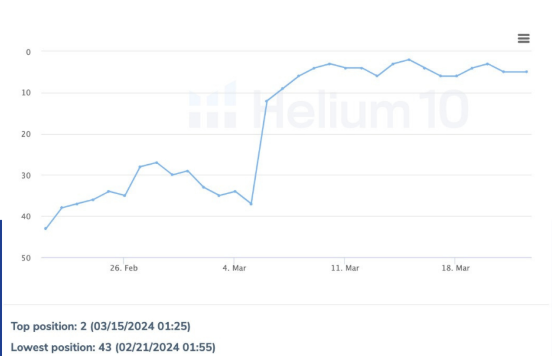
Each keyword played a different strategic role in the campaign — and the Helium 10 tracking data for each confirms the movement and tells the story of how different keyword types behave at low unit volumes.
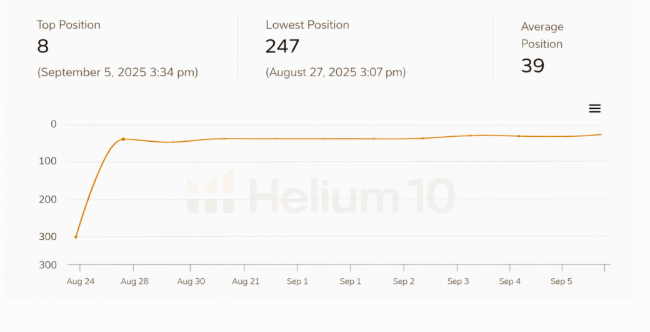
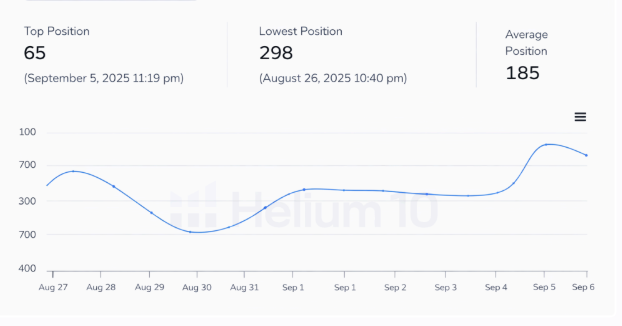
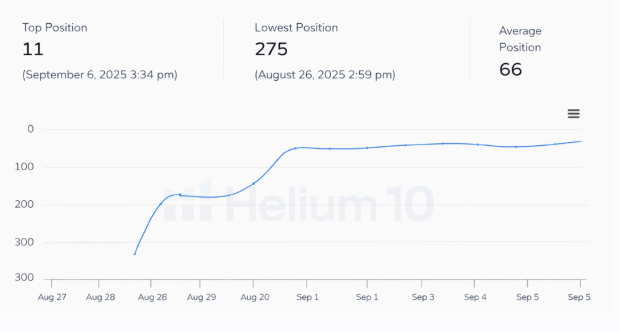
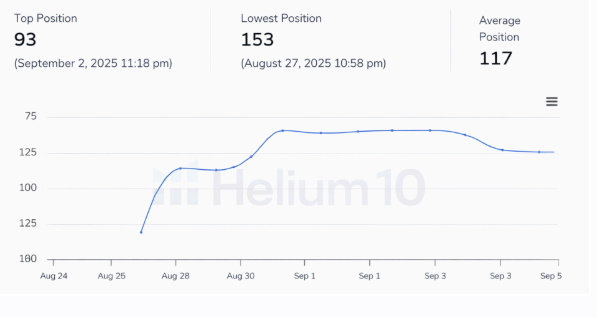
Keyword Evolution — 8 Days (Aug 24 – Sep 6)
The day-by-day Optirets tracking table confirms the trend. The colour-coded heat map shows all four keywords transitioning from deep red (300+) through orange and yellow to green as the campaign progressed. The key takeaway from the data: focus on the trend direction, not individual daily fluctuations, which are normal due to Amazon’s dynamic ranking updates.
Sales Insights
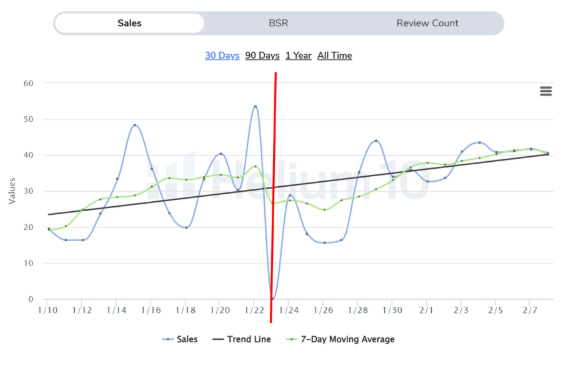
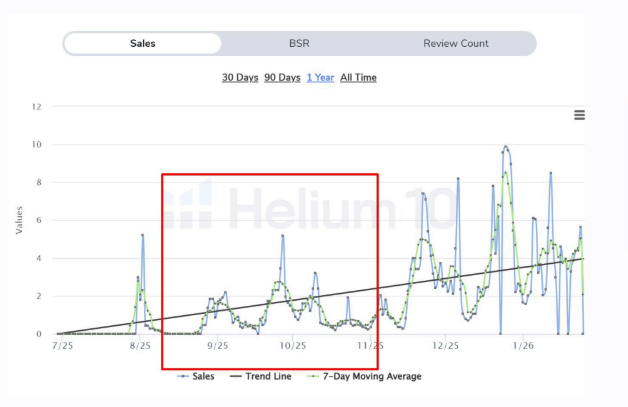
The 1-year Helium 10 sales view tells the complete story. The red-highlighted period (approximately Sep–Nov 2025) shows the campaign’s initial impact: low early activity that gradually built upward as the rankings gained organic momentum. After visibility improved, sales increased consistently and continued climbing well beyond the campaign period — confirming that the ranking gains were translating into sustained organic revenue.
Best Seller Rank (BSR) Evolution
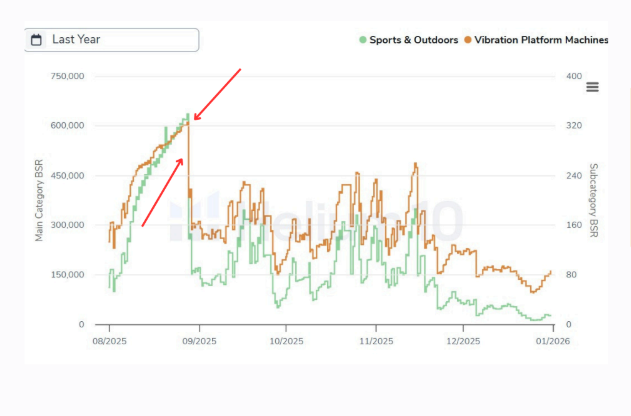
The BSR chart provides perhaps the most striking visual of the entire campaign. Prior to the campaign (August 2025), BSR was climbing — meaning the product was losing ground in its category. Immediately after campaign launch, BSR dropped sharply, indicating a strong improvement in category positioning. The positive trend maintained well into Q4 2025, demonstrating that even a small, efficient campaign can drive meaningful BSR movement for a high-ticket product.
The Real Cost of This Campaign
One of the most valuable sections of this case study is the transparent cost breakdown. For high-ticket products, the gross campaign cost looks large — but the actual net cost is dramatically lower once Amazon’s disbursement is factored in.
The gross outlay of $2,145 looks significant, but Amazon disburses $1,454 back to the seller through the normal payout cycle — leaving the true campaign cost at just $690.81, or $57.57 per unit. For a product retailing at $160, that is a highly efficient cost-per-ranking unit. The key insight for any high-ticket seller: the budget needed is far lower than it appears on the surface.
Summary
- KW1 (shake plate, 5,159 searches/month) moved from completely unranked → position #1 in 8 days.
- KW2 (shake plate exercise machine) moved from #257 → #4. KW3 (vibrating plate) moved from #129 → #4.
- KW4 (vibration platform machine) moved from #106 → #22 — the slower-moving broad category term, as expected.
- All rankings stabilised and continued improving after the campaign ended.
- BSR dropped sharply at campaign launch and maintained a positive trend through Q4 2025.
- Sales showed consistent upward growth from the campaign period through January 2026.
- True campaign net cost: just $690.81 total — $57.57 per unit — after Amazon disbursements.
- Key proof point: premium, high-ticket products can rank efficiently with low daily unit volume when keyword selection is precise.